"Histoires courtes": photography and electronic detectors

"Histoires courtes": photography and electronic detectors

On Monday documentary filmmakers Jean-Francois Dars and Anne Papillaut published a short “film” that they made about my research and photography here.  Here is a direct link to the film.
It was wonderful working with them. It was a long process: we started in April when we recorded the soundtrack. I had carefully prepared a text. But it didn’t work at all! Faced with the microphone I couldn’t recite any of the words at all. I was completely stuck. So I just started talking about what I wanted to say in french, because it seemed easier to speak to them in French about these things (I speak in French with all of my french friends and colleagues, after all it is more than ten years that I am living here now). And that was the text that they used.

Taking the photographs 

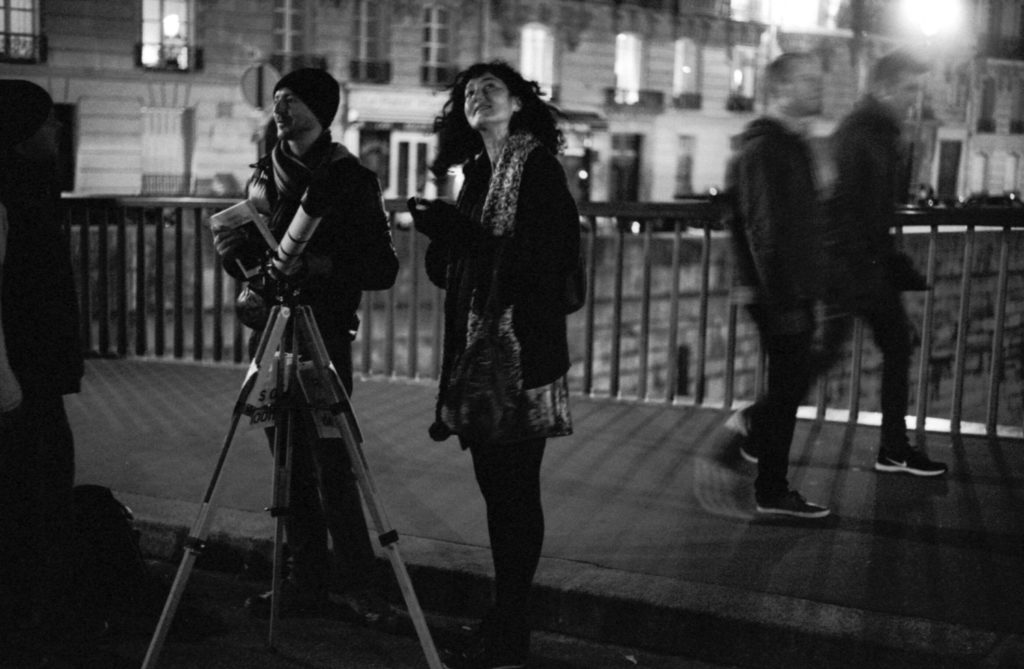
Afterwards, during the summer Jean-Francois came to my office and took a few photographs and after thata we went into the darkroom where I developed a big picture of one of the Euclid CCDs. Jean-Francois suggested that we take some pictures at night, because I had talked about how I preferred taking pictures at night on film, so a few months later we spent a wonderful winter evening together (after a nice meal of course) when we walked around the centre of Paris and took pictures.
See the craters of the moon

Or rather, I took pictures and Jean-Francois took pictures of me taking pictures. I can’t say that I approached this with some small amount of trepidation, because Jean-Francois was a friend of Kertesz, and Kertesz took the first-ever photographs of Paris at night! However, in the end I was quite happy with the photographs I took and a selection of them are on my 52rolls pages. If you look carefully, you can see Jean-Francois taking pictures of me. It was so easy to interact with people and take these pictures, it was the most natural thing in the world. I just applied my Winogrand-inspired technique of smiling a lot, even when I wasn’t sure if anyone was looking at me or not. This really does work.

Losing the photons

The “histoires courtes” are very short, most I think are under three minutes. The text and discussions were edited to focus on the key difference between electronic detectors and photographic plates: the quantum efficiency of silver grains is a lot lower than electronic detectors. In the visible spectrum, the latest CCD cameras from e2v have a quantum efficiency in the visible bands of almost 100%. Only around 4% of photons falling on film get converted into silver grains. This difference of course had some interesting consequences: in the film era, people spent a lot of time and energy trying to increase the quantum efficiency of photographic plates, “sensitising” them by baking them in the oven and so forth. Eventually photoelectric detectors came along, but alas, they were not array detectors and so making images was impossible. The arrival of electronic array detectors was a revolution: a CCD camera suddenly transformed a 2 metre telescope to a 4 metre telescope. Now today with the very high efficiency of electronic detectors in the visible bands, the only way to increase the number of electrons is to increase the size of the primary mirror. In addition to the greatly increased sensitivity of electronic detectors offer much higher angular resolution, and in most cases the electronic detectors fully sample the instruments’ response function, so the amount of detail you can record is limited by the atmospheric conditions and not the detectors. So the advantages of electronic detectors are clear for astronomers. But for photographers?

And on film?

I already wrote about this over on Leicaphilia. To take a good picture on an average day in Paris, you need an detector sensitive to say ISO400, a lens that can do f8 and a shutter speed of 1/125s. Nothing more. Most digital cameras have been able to do this for at least a decade and a half. And if you want to print your masterwork at a reasonable size – 18×24 say – in most cases ~5 megapixels suffices. Nothing more. So, you might wonder, where does that leave the last decade-and-a-half of technological development? Well, not in the service of taking pictures…
A few words for Mr. L. Cohen

A few words for Mr. L. Cohen

A message on my telephone this morning from a Canadian friend announced the passing of Mr. Leonard Cohen, songwriter and yes, let’s say it, poet. Because, unlike Bob, he really had published a few poetry collections and novels before he decided to become a singer and sing his own poems. The story goes, so I remember, is that on learning his ambitions his friends exclaimed in terror to him “don’t do it Leonard!” You see, no-one believed he could either sing or play a guitar. Cohen tells the story of how he took guitar lessons from a young Spanish man. One day he turned up at the apartment for his lesson only to find out from the landlady that the young man had committed suicide. But not before he had taught Lenny the few chords — the right ones — that he would need for his musical career. The darkest ones I guess. And now today the holy trinity is broken: Nick Cave, the son, Tom Waits, the holy ghost … and Leonard Cohen, the father.

Like a lot of people, I felt he spoke directly to me. A common phenomenon in pop music I guess: Around that time I saw REM live, and Michael Stipe exclaimed sarcastically before half of the songs, “this song is written especially for you!” But Cohen’s music came into my life at that exact time between when I left Ireland and before I became a more sociable human being, which is probably the most charitable way I can think of putting it.

I was living in Manchester, in a shared house with other students, and I had a small room at the back of the house on the last floor under the roof. Yes, really. “Songs from a room” to this tiny room where I had a large table, big enough for a record player and a place to write. You see, Cohen’s music came to me in that part of my life when I listened to music on records, before travelling made keeping a record player and records with me impossible. His music travelled directly from the little scratches on vinyl to my ears.

In his early records the songs only had guitars and his baritone, which like Waits’ deepened wonderfully with age. The words and the meaning of the words were at the center of everything. They resonated, and I can probably remember most of the lyrics of all those early songs today without any difficulty. I wrote and listened to Lenny and looked out over the rooftops of Chorlton-cum-Hardy, yes, trapped in a 19th century Universe. I would escape this world only by actually going myself, a few years later, to live in Canada. A place which did not reinforce all the heavy grooves of personality and place which are difficult to escape from when you are in your 20s. But when I was stuck deep in there, there was, at least, Mr. Cohen for me.

For this and everything, thank you Mr. Cohen!

A text for Czelaw Milosz

A text for Czelaw Milosz

After a recent trip I had been thinking once again about this poem I wrote several years ago after the death of the great poet C. Milosz. I thought I might even send it out into the world. So here it is:

I find these new words for you,
my friend from a distant country,
In those things you’d seen I found there were enough echoes
for my own times,
those building which burned for days,
that country where every line of sight intersected a field,
and finally those new cities which one could not walk out of,
girdled by roads and motorways,
a few hundred years of history burned deep into the ground.
But that was before we’d met, that would come later.
There was first another journey to make across desert and plain,
towards the mountain — for there was only one.
A strange place, the summit rounded, a grassy knoll,
no trees, no wind, a silence absolute,
something I’d never experienced before.
Standing in the driveway there I could hear the blood in my own ears.
Beneath me the long low plains where there’d once been an ocean,
Empty now right to the horizon.
How to survive this, this silence and solitude?
You spoke to me, although I had not been expecting it.
I wrote your words down, I stored them in the heart of a computer
fifty kilometers distant.
I sent them away from me by microwaves and fibre optic cable,
but kept them with me.
I commited them to memory.
I sensed there was a future and a past here,
yet to unfold.

There were more voyages.
You were with me that night in Esalen,
the waves of the pacific crashing against the darkened shoreline far
below,
my body suspended in the heated waters,
impossibly separate.
For an instant,
a fleeting thought told me what was important and what mattered,
and what did not.

And still the ground unrolled beneath my feet,
latitude clicking back towards zero.
I stood in streets with sea as an end to them,
my shadow straight and inky black beneath my feet.
Forever trying to understand when it was that your verse met this reality,
This glittering sea before my eyes.

Then this last city, perhaps the most dangerous:
An intricate hypnotic web of streets,
Ruthlessly fractured to follow the dictates of science and art,
Lines of heaven drawn to the earth.
And suddenly I found myself there at the origin,
the zero-point,
It all seemed so true,
in a way other cities could never be true.
Perfection had somehow been granted to this corner of the world.
And beyond this centre,
the Universe faded away,
greyed out,
became unreal.
Voyages were unecessary:
After all, the city was all that existed.

In this sleep, from this distance,
I read your words again,
I layered your verse onto the buildings and streets around me,
And through them,
Walls and and buildings became transparent,
The city shrank, the world returned.

How does this end?
The traveller, perhaps, may not return to his point of origin.
There are lines which are only that, lines, which do not connect.
And I am in the present, and the past is the past.
I am underground, and far above I see the small disk of sky,
an undiscovered blue planet.
The roads and lines radiate outwards around me.
A parallel universe to the streets and cafes above.
I hestiate, of course.
At the exit, who knows?
But in my mind there is the amulet of your verse.
I start walking.

"Virage analogique"

"Virage analogique"

Here I am again, after six months. It was interesting to read the post below once again last night. You see, a weird thing happened between here and there. A few days after I wrote this blog post, I went to a shop here in the 14th in Paris and bought a roll of HP5+, a black and white film produced by Ilford camera. I put it in inside an old camera I still had here in a box, and started to take pictures. I was curious to see how it would turn out.

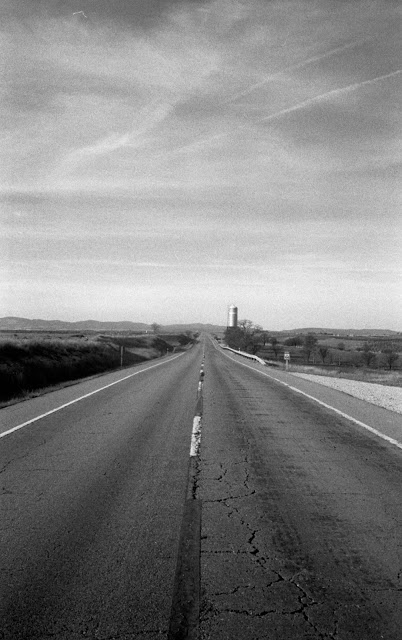
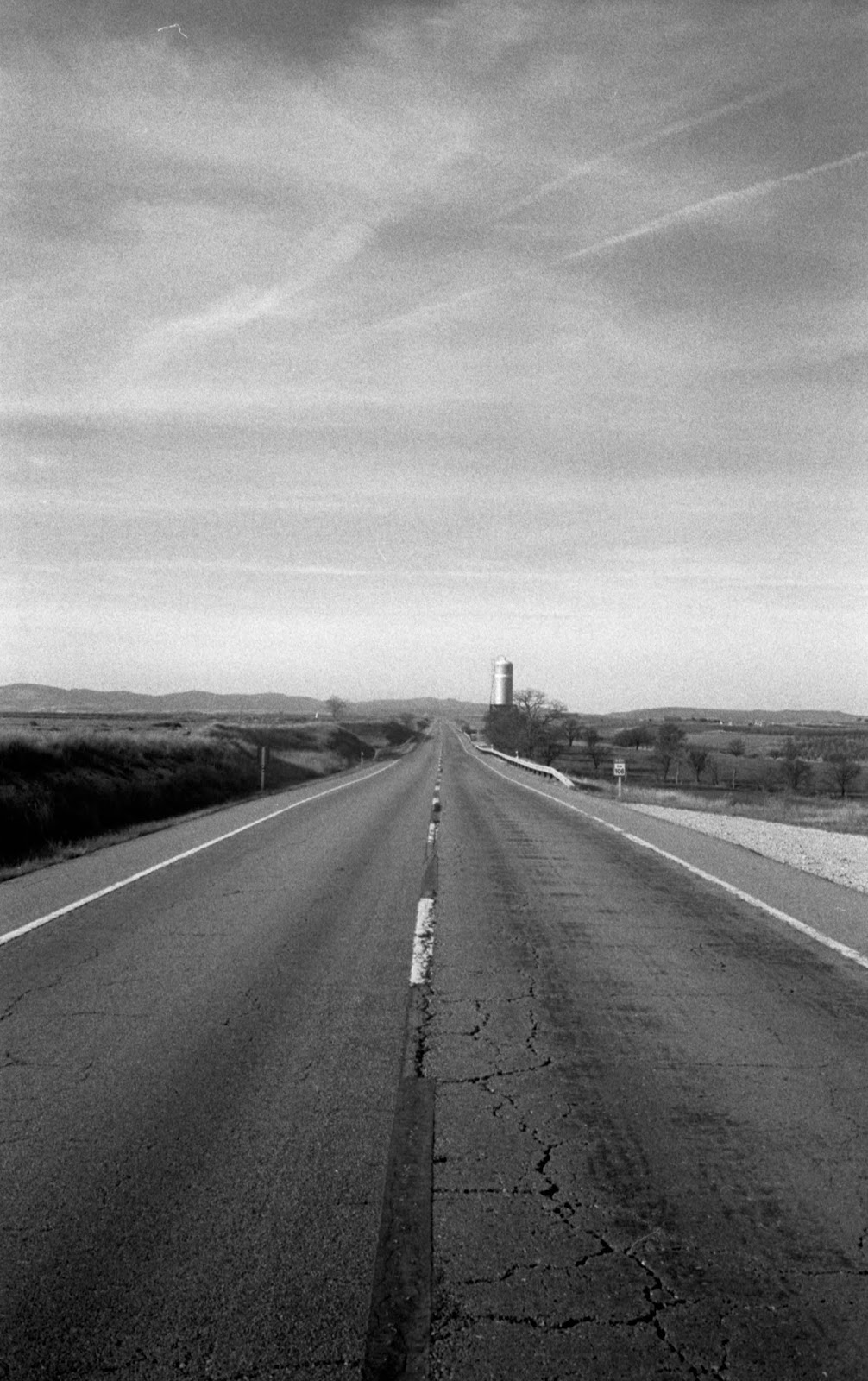
Well, now on the first week of January, I have filled more than 50 rolls of film with images. As well as the Pentax, I tried an Olympus XA rangefinder, and then in June I bought a Leica M6. Mostly because I was frustrated by the lack of control on the Olympus – developing and scanning photographs is a lot of work and it’s frustrating when something doesn’t turn out right and it was the camera’s fault. Anyway, at least with the Leica if it doesn’t work out, it is always your fault, and you can improve and learn how to do it better next time. So it maybe it is a “virage analogique” but for me it is now a straight road, like the one below I took during a recent trip to Spain:

I’m reminded of the blog post I wrote a few years about the Amazon Kindle and paper books, and Victor Hugo’s Ceci tuera cela. Except in this case, it would be a film camera on the left and a digital camera on the right. But I think in this case it is worse, because film photography and digital photography are completely different. In the case of books, one would hope, the words are the same in both cases. But that is a reflection for another time. Anyway, I don’t want this blog to become devoted to photography (sighs of relief from the occasional one or two people still reading). I wrote my up my experience on a lengthy text which will appear on a certain photography-related site sometime soon. I have also committed myself to take at least one roll of film on the M6 with a 50mm lens per week. That experience you can follow over at 52rolls, and my posts will be here: http://52rolls.net/author/hjmcc/ . In the mean-time I will try to write at least one post per month over here. At least.